My experience with medico-legal causation
It’s worth expanding a little bit more on my history exploring concepts of medico-legal causation in two contexts:
- Medico-legal system design and human rights.
- Overlap and similarities with current debates in tech policy.
tech policy context
Current debates in tech policy relate to whether harm has been inflicted on particular groups of people as a result of their usage of particular technologies, or particular design decisions made in the way technology is developed and deployed. This can be seen most prominently in:
- the advocacy conducted by Jonathan Haidt around smartphone usage among young people, and use of social media, including impacts on mental health.
- discussions about the impact of misinformation and disinformation on things like social cohesion, voter behaviour, or polarisation.
- discussions about how to determine what is or is not factually reliable in making content moderation assessments of particular claims – for example, around the risk of vaccine side effects.
My prior work in a medico-legal context gives me a useful foundation for understanding the different kinds of causative assessments being made by different disciplines, and the role and limitations of medical, scientific and other kinds of evidence in either individual cases, or at a population level.
Medico-legal causation
Medico-legal causation is a core concept in New Zealand’s personal injury system. I have seen it investigated in hundreds of judicial decisions, administrative reviews, and medical reports. For our report “Solving the problem” I also reviewed statutory causation tests throughout the New Zealand statute book.
Assessing medico-legal causation involves a complex interaction between concepts of legal causation and medical/scientific causation which has led to substantial difficulty in the assessment of whether someone’s current health condition has been caused by one set of circumstances (an accident or other qualifying event) or another (the ageing process, “degeneration”, non-qualifying events). This has led to substantial actual and perceived injustice and extensive news reporting, litigation and other consequences.
Human rights implications
Given the substantial legal and financial consequences of causation assessments, public sector agencies are incentivised to expend significant amounts of resources on the investigation of causation, with injured people being unable to match that resource expenditure. Public sector agencies also have final say - despite principles of informed consent - over who will perform a causation assessment, and when a satisfactory evidential threshold has been met. This presents injured people - who by definition cannot work because of the consequences of their injuries - with an insurmountable hurdle to accessing entitlements.
Resolution through regulatory design
All of this flows from an institutional approach to causation that treats it as an absolute question of evidence and fact, when only probabilistic or principled conclusions are achievable. “Causation” is not defined in relevant legislation and the body of case law exploring the concept is also complex and meandering in quality, so inaccessible to ordinary people. Given the volume of causation assessments performed by public sector agencies, very few of them wil ever be subject to independent judicial scrutiny.
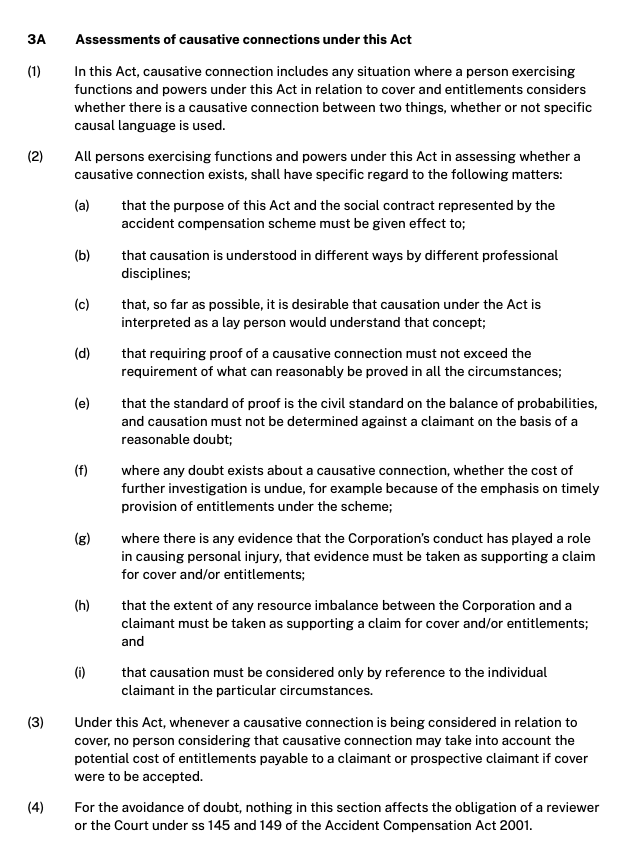
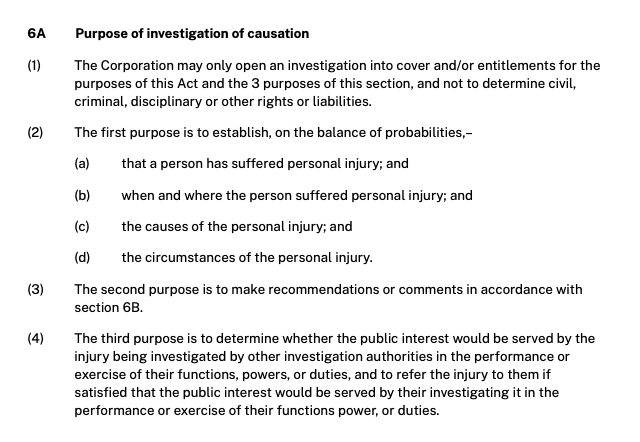
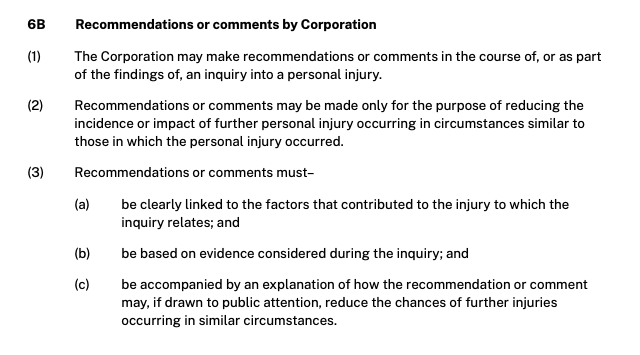
To resolve these issues we proposed implementing a statutory definition of causation in the personal injury system to make it clear what level of evidence and certainty is required and impose a limit on the extent of investigation that can be conducted. We pointed to other areas of the law in New Zealand (specifically the Coroners Act) where different kinds of causation tests were defined in order to better fit the policy context, and used these as a basis for the proposed amendments. We emphasised that reforming the tests in this way would actually make the scheme easier to administer, simpler for staff, and reduce the burden of evidential assessments on justice and health systems.
Proposed statutory amendments
The proposed statutory amendments are below: